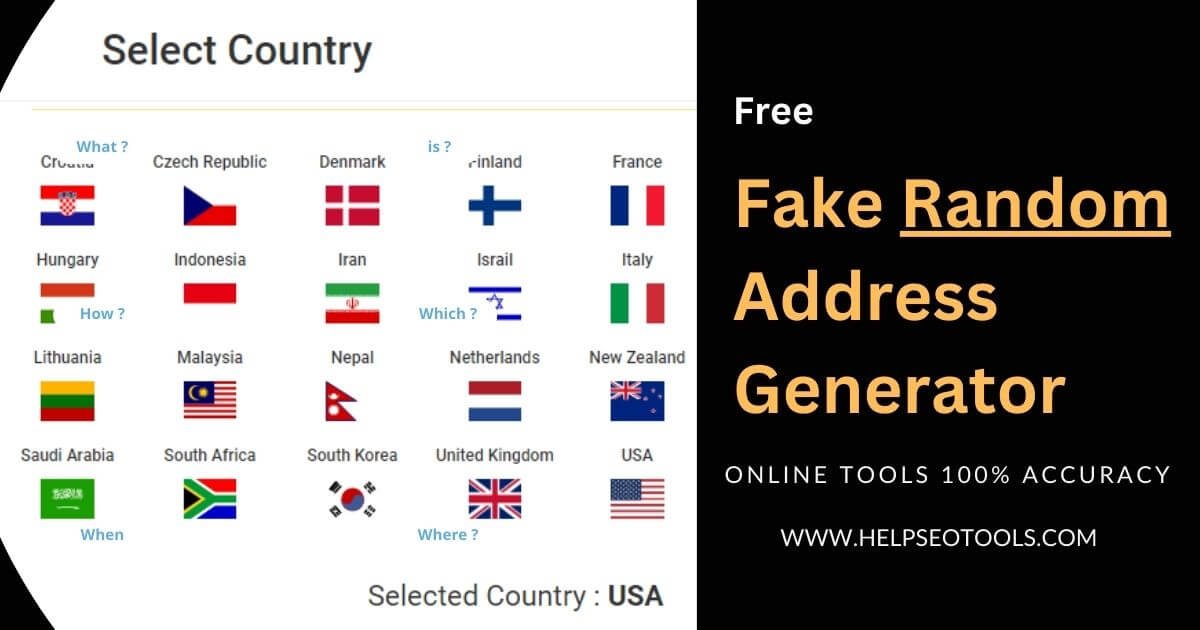
In a world increasingly reliant on digital interactions, where every click, sign-up, and online purchase contributes to a vast personal data footprint, the quest for privacy has never been more urgent. We're well beyond the simple act of trying to obscure an IP address. Today, safeguarding our digital selves—and for developers, our users' data—demands a more sophisticated toolkit. This is where the powerful concept of Beyond Fake Addresses: Related Tools for Data Generation & Privacy steps in, offering a vital line of defense and efficiency.
Gone are the days when a simple dummy email sufficed. The landscape of 2026 demands a nuanced approach, acknowledging that data collection is not just pervasive but often mandatory. From students signing up for countless educational platforms to developers needing robust, yet anonymous, datasets for critical testing, the need for realistic, non-identifiable information is paramount. This guide unpacks how modern data generators serve as an indispensable ally in this fight, securing privacy without compromising functionality or ethical standards.
At a Glance: What You'll Discover
- The Evolving Need for Synthetic Data: Why the digital landscape in 2026 makes privacy tools essential for everyone.
- From Fake Addresses to Full Datasets: Understanding the leap from simple address generators to comprehensive fake data tools.
- How Developers Build Safely: Using synthetic data for robust application, API, and database testing.
- Empowering Students & Researchers: Leveraging these tools for educational sign-ups, ethical research, and avoiding unwanted marketing.
- The Anatomy of a Powerful Data Generator: Key features like flexible field editors, diverse data types, and secure output.
- Ethical Foundations: Distinguishing legitimate privacy protection from fraudulent misuse.
- Practical Steps for Generation: A quick guide to creating your own privacy-preserving datasets.
- Best Practices for Seamless Integration: Tips for maximizing the utility and security of generated data.
The Unseen Digital Trail: Why Synthetic Data Matters Now More Than Ever
Every online interaction leaves a trace. For many, this is a subconscious byproduct of convenience. We accept cookies, agree to terms of service without reading, and input personal details into forms that feel innocuous at the time. Yet, the cumulative effect is a vast, detailed profile of our lives, often shared and retained far longer than we'd prefer. This omnipresent data collection, coupled with mandatory account creation even for seemingly "free" tools, has created a pressing need for digital self-defense.
Think about the increasing trend of platforms demanding billing profiles for free trials, or regional availability checks that require a home address. This isn't just about avoiding a deluge of marketing emails; it's about preventing long-term profiling and segmenting your digital identity. For students especially, whose academic journey often involves signing up for dozens of platforms, linking their home location to every learning tool or research database can create an unnecessarily large digital footprint.
This is where the power of synthetic data truly shines. It allows individuals to navigate the digital world, access services, and fulfill requirements without exposing their genuine personal information. It's a proactive measure against the over-collection and potential misuse of data, framing privacy protection as an essential skill in the modern age.
Beyond Just an Address: The Rise of Comprehensive Data Generators
Initially, tools like a simple street address generator were often used for basic form filling or to test address fields. These clever utilities create structurally valid, region-specific addresses that look real but aren't tied to any actual person or residence. They are, by design, perfect for avoiding the disclosure of your true location when it’s not strictly necessary.
However, the modern digital ecosystem demands more than just a fake street address. Applications, databases, and APIs rarely operate with just one piece of information. They require names, emails, phone numbers, transaction histories, dates, and much more. This is where the evolution to comprehensive fake data generators becomes critical.
These advanced tools allow you to create entire, realistic datasets—a full profile, not just a single data point. Imagine needing not just an address, but a corresponding name, email, phone number, and perhaps even a date of birth for a test user. A fake data generator makes this seamless, crafting varied, believable information that mimics real-world patterns without ever touching a genuine individual's data. It’s the difference between sketching a single tree and rendering an entire, vibrant forest.
How Developers Secure Their Staging & Test Environments
For developers, testers, and data analysts, the ability to generate realistic sample data without resorting to real personal information is not just a convenience; it's a fundamental pillar of responsible development and compliance. Using actual user data in development, staging, or even internal testing environments is a serious privacy risk, often violating GDPR, CCPA, and other data protection regulations. Fake data generators eliminate this peril entirely.
Building Robust Applications Without Real User Data
Application testing is where synthetic data truly flexes its muscles. Developers need to verify functionality across a myriad of scenarios:
- Form Validation: Ensuring input fields correctly handle different data types and reject invalid entries.
- Shipping Logic Simulation: Testing how various addresses impact shipping costs, delivery zones, and tax calculations without actually processing a real order.
- Geo-Based UI Testing: Seeing how the user interface adapts to different regional settings or address formats.
- Edge Case Handling: Pushing the boundaries with extremely long names, unusual characters, or boundary numeric values to ensure the application doesn't crash.
By populating their test environments with varied, realistic fake data, developers can thoroughly vet every aspect of their application, catching bugs and optimizing performance long before real users ever interact with it.
Safeguarding APIs and Databases
APIs are the backbone of modern software, connecting services and sharing data. Testing these crucial interfaces often involves sensitive fields like payments, e-commerce transactions, or identity verification. Using real customer data in API testing can lead to accidental real-world transactions, expose sensitive information, or violate privacy agreements.
Fake data generators provide mock API responses, populate test databases, and allow for rigorous performance and stress testing without compromise. Imagine setting up a public test environment for an API you're building; with synthetic data, you can share it widely, allowing other developers to build against it without any privacy concerns. For database administrators, these tools are invaluable for:
- Populating Test Databases: Quickly filling tables with thousands of records for query optimization and index testing.
- Performance Benchmarking: Stress-testing database queries and server performance with realistic data volumes.
- Schema Validation: Ensuring the database schema handles various data types and relationships correctly.
Open-Source Projects and Demos
Sharing code or demonstrating functionality for an open-source project or client pitch requires realistic examples. However, embedding real user data, even anonymized, carries inherent risks. Fake data ensures that examples remain relatable and functional, yet completely safe for public consumption and reuse. It guarantees that no real person is inadvertently exposed, protecting both the developer and potential users.
Empowering Students and Researchers with Privacy-Preserving Tools
The digital age has fundamentally changed how students learn and researchers conduct their work. While the internet offers unparalleled access to resources, it also presents unique privacy challenges. Fake data generators offer a powerful solution, enabling students and academics to engage fully without oversharing.
Navigating Educational Platforms with Confidence
Modern education heavily relies on online platforms, from learning management systems to specialized subject tools. Many of these require sign-ups that request personal details, including addresses, often for demographic reporting, account verification, or regional availability checks. Students can leverage fake address generators to:
- Protect Home Location: Avoid directly linking their physical residence to every educational platform, especially those with questionable data retention policies.
- Separate Academic from Personal Identity: Create a distinct digital persona for academic tools, minimizing the cross-referencing of personal and educational data by third parties.
- Prevent Marketing Intrusion: Sidestep the influx of unwanted marketing mail or email campaigns often triggered by sign-ups.
This ethical use of synthetic data respects terms of service while empowering students with a degree of digital autonomy.
Research and Surveys: Building Ethical Datasets
For academic projects requiring mock data, students and researchers face a crucial dilemma: how to build realistic datasets for analysis, modeling, or public sharing without compromising real individuals' privacy. Traditional methods often involve laborious manual data creation or the use of heavily anonymized, but potentially less realistic, real data.
Fake data generators offer an elegant solution:
- Mock Data Generation: Create vast, varied datasets that perfectly fit the requirements of academic projects, allowing for robust statistical analysis or model training.
- Ethical Data Sharing: Share research projects, codebases, and examples publicly without any risk of accidental doxxing or privacy breaches, adhering to strict ethical guidelines.
- Dataset Building for Machine Learning: Generate synthetic data that closely mimics real-world distributions, crucial for training machine learning models in privacy-sensitive domains where real data is scarce or restricted.
This approach aligns perfectly with ethical research practices, fostering transparency and replicability without compromising individual privacy.
Free Trials and Temporary Access: Smart Digital Consumption
Many online services offer free trials or temporary access to their tools. While incredibly useful, these often come with the implicit cost of providing personal information that can lead to persistent marketing, long-term profiling, or even unwanted subscriptions if you forget to cancel.
Students and curious users can employ fake data for:
- Trialing New Tools: Explore software or services without leaving a permanent digital trail linked to their real identity.
- Avoiding Marketing Overload: Prevent companies from adding them to endless marketing lists or sending physical junk mail.
- Maintaining Digital Cleanliness: Keep their primary email inbox and physical address free from non-essential communications, separating temporary interests from core personal information.
This conscious use of synthetic data allows for a more discerning and private digital consumption experience.
Unpacking the Anatomy of a Robust Data Generator
What makes a fake data generator truly powerful and useful? It's not just about spitting out random words; it's about intelligent, configurable realism. The best tools offer a blend of flexibility, variety, and secure operation.
Flexible Field Editors: Your Data Blueprint
At the core of any advanced data generator is a flexible field editor. This feature allows you to design custom data structures that precisely match your application's schema, database tables, or API requirements. You can:
- Name Fields: Label fields intuitively (e.g.,
firstName,customerEmail,shippingAddress). - Select Data Types: Choose from a wide array of predefined types, ensuring the generated data makes sense for its intended use.
- Arrange Structure: Organize fields logically, mirroring the real-world relationships of your data.
Over 17 Built-In Data Types: The Palette of Realism
A comprehensive generator comes packed with a diverse library of data types, enabling you to create incredibly realistic datasets:
- Personal Information: Full names, first names, last names, email addresses, phone numbers.
- Location Data: Full addresses, cities, states, zip codes, countries.
- Numeric Values: Integers and decimals, with configurable minimum and maximum ranges to ensure realism (e.g., age between 18 and 100).
- Text Data: Lorem Ipsum paragraphs or configurable length strings, useful for descriptions or comments.
- Dates: Generate dates within specified ranges, perfect for simulating transaction dates, birth dates, or event timestamps.
- Boolean Values: True/False, Yes/No, useful for flags or status indicators.
- Unique Identifiers: UUIDs (Universally Unique Identifiers) for creating distinct record keys.
- URLs: Valid URL formats for website or resource links.
- Custom Values: Define your own static values or patterns using regular expressions, offering ultimate control.
Advanced Configuration Options: Fine-Tuning Reality
Beyond selecting a data type, robust generators allow you to fine-tune the output. This might include specifying the length of text strings, setting the precision for decimal numbers, or defining the exact start and end dates for date fields. These granular controls are crucial for generating data that not only looks real but also adheres to your specific constraints.
JSON Output: Seamless Integration
The industry standard for data exchange, JSON (JavaScript Object Notation), is the preferred output format for most advanced fake data generators. This clean, human-readable format makes integration incredibly straightforward:
- API Testing: Easily copy and paste JSON objects into tools like Postman or Insomnia for mock API responses.
- Database Import: Import JSON directly into NoSQL databases or use scripts to transform it for relational databases.
- Application Development: Use generated JSON as seed data for initial application setup or testing environments.
Your Toolkit for Ethical Data Generation: Best Practices
Generating synthetic data is powerful, but like any tool, it comes with responsibilities. Adhering to best practices ensures you harness its full potential while upholding ethical and security standards.
Match Your Schema, Mirror Reality
The most effective synthetic data is that which closely resembles your actual production data's structure and characteristics.
- Align Field Names and Types: Ensure the field names (
customerName,productID) and data types (string, integer) in your generated data precisely match your database or API schema. This prevents errors and makes the data immediately usable. - Realistic Ranges: Configure numeric fields, dates, and even text lengths to fall within plausible ranges. For example, an
agefield should typically be between 18 and 100, not 1,000. This makes your testing more meaningful.
Test Edge Cases, Validate Thoroughly
Don't just generate "happy path" data. Push the boundaries to identify potential vulnerabilities.
- Generate Diverse Datasets: Create batches with various configurations: minimal fields, maximum length text, boundary numeric values (e.g., ages exactly 18 or 100).
- Validate Output: Always review a sample of your generated data to ensure correct formatting, adherence to patterns, and realistic ranges. A quick scan can catch misconfigurations before they impact testing.
Appropriate Volume: Start Small, Scale Smart
Managing data volume is key for efficient testing.
- Start Small for Configuration: Begin with small datasets (e.g., 5-10 records) to verify your field configurations are correct and the data looks as expected.
- Scale for Performance: Once confident, generate larger batches (up to 500 records at a time) for performance testing, stress testing, and simulating real-world data loads.
Pair with a Privacy Ecosystem
While fake data generators are a cornerstone, they're most effective when part of a broader privacy strategy.
- Disposable Emails: Combine fake addresses and names with disposable email services for sign-ups, further insulating your primary inbox.
- Password Managers: Use robust password managers to create unique, strong passwords for every platform, even those using synthetic identity.
- Separate Browser Profiles: Maintain distinct browser profiles for personal and "synthetic" online activities to prevent cross-tracking.
- Avoid Reusing: Never reuse the exact same fake address or data set across multiple platforms. This minimizes the chance of cross-platform correlation and enhances your privacy.
Never for Legal Documents
It's crucial to reiterate: fake addresses and synthetic data are NEVER for legal documents. This includes contracts, government forms, tax records, banking applications, or any situation where legal identity or residency is required. Misrepresenting information in these contexts is fraud and carries severe legal consequences. Ethical use prioritizes privacy and safety, not exploitation or deception.
A Word on Ethics and Legality in a Data-Driven World
In 2026, the distinction between synthetic data usage and fraudulent misrepresentation is clearer than ever. Most jurisdictions recognize the legitimacy of using synthetic data for testing, learning, and privacy protection, provided it meets specific criteria:
- No Impersonation: You are creating a synthetic identity, not attempting to impersonate a real, living person.
- No Financial or Legal Harm: The generated data is not used to defraud, evade legal responsibility, or cause financial damage to any entity.
- Respecting Terms of Service: While providing non-identifiable data for a free trial is generally accepted, using it to bypass payment for a paid service would violate terms and likely be unethical or illegal.
The global trend is towards greater data protection, with users increasingly embracing "digital self-defense" through ethical means. Developers, too, are relying more on synthetic data to build secure, compliant applications. This approach is not a loophole; it's a legitimate, widely accepted strategy for navigating a digital landscape characterized by pervasive data collection.
Practical Steps: Generating Your First Dataset
Ready to try it out? Here’s a quick guide to generating your first batch of privacy-preserving data using a typical fake data generator:
- Set Your Entry Count: Decide how many records you need. Start with a small number, say 5-10, for initial setup and verification. Most tools allow batches up to 500 entries at a time.
- Add Your Fields: For each piece of data you need, create a new field. Think about your application's forms or database columns.
- Configure Each Field:
- Field Name: Give it a meaningful name (e.g.,
fullName,emailAddress,age). - Data Type: Select the appropriate type from the list (e.g., "Full Name," "Email," "Integer").
- Options: Fine-tune with specific settings. For an "Integer"
agefield, set min to18and max to99. For a "Text"descriptionfield, specify a length range.
- Add More Fields: Repeat step 3 until your desired data structure is complete.
- Remove Unwanted Fields: Easily delete any fields you decide against.
- Generate Data: Click the "Generate" button. Instantly, your data will appear, typically in a clean, formatted JSON output.
- Copy and Use: Copy the JSON and paste it directly into your application, database import tool, API testing client (like Postman), or unit test files.
Important Note on Privacy: Reputable fake data generators perform all generation client-side, in your browser. This means no field configurations or generated data are ever stored, transmitted, or logged by the tool's server. This ensures complete privacy and often allows the tool to even work offline after the initial page load. Always check a tool's privacy policy for this critical detail.
Common Questions & Misconceptions About Synthetic Data
Let's clear up some common queries about these powerful tools.
Q: Can I save my field configurations for later?
A: Most fake data generators save configurations only for your current session. Refreshing the page typically resets them. For persistent schemas, you'd usually copy and paste the JSON schema into a text editor or version control.
Q: Is the generated data truly random?
A: Yes, the values are generated from large pools of realistic options or algorithms designed to produce varied, random outputs, ensuring unpredictability and diversity in your datasets.
Q: Can I create nested data structures (e.g., an address object inside a user object)?
A: Many generators produce flat JSON objects by default. However, you can often achieve nested structures by using the "Custom Value" data type and manually embedding JSON strings within it. Advanced tools might offer direct nesting capabilities in future iterations.
Q: Can I use these tools if I'm offline?
A: Yes, for tools that perform all data generation client-side in your browser, they will often work offline after the initial page load, as they don't rely on server communication for generating the data.
Q: What if I need more than 500 records at once?
A: If you need significantly larger datasets (thousands or millions), you would typically generate multiple batches of 500 records and combine them programmatically, or explore more specialized enterprise-level synthetic data solutions.
Q: Are these tools for committing fraud?
A: Absolutely not. They are specifically designed for privacy protection, ethical testing, and learning. Using them for financial fraud, identity impersonation, evading legal responsibility, or misrepresenting residency for legal benefits is illegal and highly unethical.
Embracing a Privacy-First Future
The era of cavalier data sharing is drawing to a close. As digital citizens and responsible developers, we have a collective duty to champion privacy. Tools that generate synthetic data, evolving from simple fake address generators to sophisticated dataset creators, are not just a convenience; they are essential for navigating the complex digital landscape of today and tomorrow.
By understanding their capabilities, adhering to ethical guidelines, and integrating them into our workflows, we can build more secure applications, conduct more robust research, and protect our personal information with greater confidence. The future of digital interaction is one where privacy is by design, and synthetic data generators are at the forefront of making that a reality. It’s time to move beyond passively accepting data collection and actively embrace the tools that empower us to control our digital destiny.